How new book trolleys allow volunteers to bring patients like Sallie moments of distraction and relief.

Thanks to you, patients like Sallie can find comfort in a book, immersing themselves in stories that provide solace during challenging times.

The hospital library service is offered weekly across Leicester’s Hospitals, providing a wide selection of reading materials, including fiction, non-fiction, word searches, crosswords, magazines, and newspapers.

Volunteers Marium and Madonna bring distraction and relief to patients across the wards

This cherished service has been made more efficient with the introduction of three new library trolleys, funded by your generous support. These trolleys are lighter and easier to manoeuvre through the wards, a significant improvement over the old trolleys that were donated from a local library years ago and allow the team of volunteers to get books easily on to the wards for patients to read. The old trolleys were heavy and difficult to steer, making it challenging for volunteers as they visited around 300 patients across ten wards each week.

Across three hospital sites, a dedicated group of volunteers bring this joyous service to life. Each year, they hand out over 1,600 books to patients, ensuring that everyone has access to a world beyond their hospital bed. Volunteers, like Madonna and Marium, choose to spend their spare time making a difference in the lives of others. Both are known for their caring and professional approach, taking the opportunity when delivering the books to chat with patients, ask about their reading preferences, and even take requests.
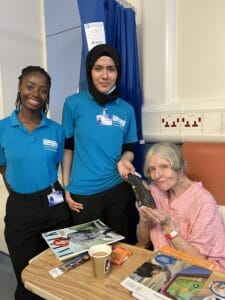
Sallie was comforted in finding a great book to read during her stay in Ward 36 at LRI

The trolleys bring more than just books, they offer a unique way for the volunteers to engage with the patients and make meaningful connections.

Madonna is a recent graduate and has been volunteering for the last four months. She said “I feel incredibly privileged to bring a little bit of comfort to patients and see smiles on the faces of people who can sometimes be very poorly.” For patients like Sallie from Whitwick in Leicestershire, the service has been a wonderful addition during her stay. Sallie found herself in need of emergency care at Leicester Royal Infirmary following a serious fall. The news of a blood clot behind her knee was worrying, but the library service offered a welcomed distraction.

Sallie is deeply grateful for this service, which reminded her of the simple pleasures of reading during a challenging time. “There’s nothing better than holding a book in your hands and becoming engrossed in a story. I was so pleased when the volunteers unexpectedly arrived to offer me some great books to read. It really took my mind off the bad news I received earlier” Sallie explained

Thanks to your thoughtful gifts, our volunteers no longer need to struggle with outdated trolleys. This improvement has not only made their job easier but has also allowed them to spend more time engaging with patients, bringing moments of light relief and joy to those who need them most.
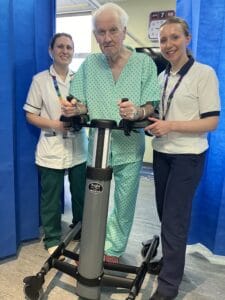
Two brand new hydraulic walkers are now in use on Leicester Royal Infirmary’s trauma wards, only made possible by your generosity.

These top-of-the-range walkers help in the recovery of patients who have suffered a physical trauma through improved manoeuvrability and personalisation during physiotherapy.

The new walkers can be easily adjusted to suit each patient’s individual needs. They feature hydraulic height adjustment, fully adjustable armrests, and adjustable foot brakes. These features ensure that each patient can use the walker in a way that best supports their mobility and comfort, providing a customised experience that promotes independence during rehabilitation.

George using the new walker with confidence after his hip operation

George, from Groby in Leicestershire, recently experienced a fall and suffered a hip fracture. Following his surgery, the dedicated physiotherapy team on the ward have been helping him regain his strength and ability to walk.

Standard walking apparatus currently used for trauma patients are widely available on the wards and are adequate for rehabilitation. However, they do not offer as much personalisation compared to the new walkers. The added customisability and support of the walkers help to provide even better care for hundreds of patients just like George.

George shared his experience, saying, “I feel incredibly secure using the new walker, and I’m able to manoeuvre easily up and down the ward to do my exercises. The standard walkers on the ward are okay, but I feel much more restricted using them. Thank you to the kind donors who helped to fund these new walkers for patients like me.”

Emma and the team are delighted to help patients with the new walkers and provide even better care

Emma Robery, Senior Physiotherapist at Leicester Royal Infirmary, emphasised the importance of the new equipment. “It’s very important in the healing process that patients undertake physiotherapy and are able to manoeuvre in a safe and secure manner.” she explained.

Emma added, “We have already seen a really big difference in the confidence of our patients who use the new walkers – even the first day after their surgery. This means that some patients find their physiotherapy easier and recover faster, allowing us to discharge them sooner to the comfort of their own homes. It would be great if we could have more of the walkers across the Trauma Unit.”

It is only because of the generous gifts provided by people like you that patients like George now have access to the very best equipment that aids in their recovery, giving him more control, and a better sense of security and confidence that was not possible before.

Your support is making a real difference in the lives of trauma patients at Leicester Royal Infirmary, helping them on their journey to recovery.


Thanks to your kind gifts, Aryan can meet other children just like him.

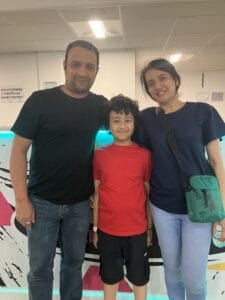
Aryan with his mum Rupa and dad Sailesh

Just before he turned four, Aryan was diagnosed with type 1 diabetes. His mum Rupa didn’t recognise
the symptoms at first, she didn’t even know children could have diabetes and with no history of the disease in her family, Aryan’s diagnosis came as a complete shock. It was a struggle accepting the challenges of Aryan’s illness, he didn’t like the daily injections and Rupa found it hard to hold back tears when he resisted them.

Aryan began to feel like he was different to other children, and he didn’t want to wear an insulin pump because that would make him stand out even more. He just wanted to fit in with the other children and feel normal. Sadly, this experience is all too common for families navigating the challenges of diabetes. Nobody knows this better than Katy Sparrow.

As a Senior Specialist Dietician at Leicester Royal Infirmary, she saw firsthand how some of her patients and their families felt alone in their struggle. So, Katy had a bright idea – to create a group away from a clinical setting to bring children and families together.

And that’s how the ‘Highs and Lows’ group began. Because of generous supporters like you, this
special group of children and their parents can meet up four times a year for activities like bowling, picnics, crazy golf and even trampolining. The wonderful diabetes team of specialist nurses, psychologists and consultants volunteer their time during evenings and weekends to ensure the events are a success. Katy said “It’s wonderful to be able to help so many families find the support they need in each other. More and more families are joining the group for each session, allowing them to build connections, share experiences, and create a strong community of care and understanding.”

The ‘Highs and Lows’ group excited to bounce with friends at a trampoline park in Leicester

The first time Aryan and Rupa attended, they met the group at mini golf. Aryan was a little shy at first, but as he started playing with the other children, something great happened. Spending time with other children like himself gave Aryan a sense of belonging he had never experienced before. And seeing other children wearing their insulin pumps gave him the confidence to wear one himself.

Now, at eight years old Aryan is passionate about helping other children with type 1 diabetes. He wants to start a YouTube channel and make videos teaching other children how to do finger prick tests, how to change their insulin pumps, and what to do if their blood sugars are low. He even wants to be a Diabetes Doctor when he grows up. Aryan and Rupa are already looking forward to the next event, when they’ll be joining the rest of the ‘Highs and Lows’ group for a picnic in the park.

Your generosity means Aryan and his friends can continue to meet up and inspire each other. Highs and Lows is so much more than a social event, it’s helping to build a community of resilient families who can find support in each other.

Patients like Karen have a greater sense of control during their care, thanks to the arrival of cold cap therapy that helps to prevent hair loss during chemotherapy.

Because of incredible support from people like you, more patients can now choose to receive treatment to prevent hair loss during their chemotherapy. Ten new cold caps along with three new cooling systems are now available to patients who can choose the therapy during their chemotherapy infusion.

This simple therapy consists of a cap attached to a cooling system, which circulates coolant liquid around the inner cap, reducing the temperature of the scalp. This helps to protect the hair follicles and limits the damage caused by chemotherapy drugs.

Karen, from Uppingham in Rutland was diagnosed with triple-negative breast cancer in May 2024. “It was out of the blue, a complete shock. I went into a spiral, googling everything to find out what was going to happen,” she recalls.

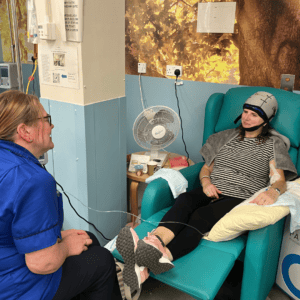
Cold cap therapy is helping Karen to hold on to her identity

During her extensive research Karen found out about the cold cap therapy and asked about them during her initial appointment. “The breast care nurses explained how it would work, and the oncology nurse sent me a link to the website, which had videos and stories about the therapy” Karen explained.

Karen is an A Level Biology Teacher, and this fuelled her need to understand the therapy in detail. She felt able to make an informed choice about something that felt deeply personal. “When you think about cancer, you think about hair loss. It’s not the be all and end all, but I didn’t want to be just someone with cancer. I wanted to meet friends and walk down the street without people staring and saying, ‘That’s the lady with cancer.’”

Clair is proud to offer patients the choice of cold cap therapy

Clair Burroughs is a Macmillan Lead Systematic Anti-Cancer Treatment (SACT) Nurse and emphasised the importance of providing patients with options like cold cap therapy. “It’s about mitigating the psychological impact that hair loss can have on patients. It’s valuable and empowering to give patients a choice, especially during a time when they don’t feel like they have many options.”

Kerry, a Clinical Aid explained, “It feels good to give patients the choice of cold cap therapy. It feels like we can give them a small sense of normality by offering a therapy that helps to reduce the possibility of hair loss – something that a lot of people struggle to come to terms with.”

It’s been several weeks since Karen first began her treatment, and the therapy is working, Karen has been able to keep her hair.

It is because of your generosity that patients like Karen can keep hold of their identity, giving them the strength to carry on fighting.

Every second counts for the team at the Cardiac Angiocatheter Suite. Thanks to your gifts, new life-saving equipment is helping staff to gain crucial seconds that help to save lives

A state-of-the-art robotic cardiopulmonary resuscitation (CPR) device, known as LUCAS 3.1 is now transforming care at Glenfield Hospital’s Angiocatheter Suite.
The LUCAS chest compression device delivers high-quality compressions with fewer interruptions than manual CPR. This enables staff to focus on treating the patient’s underlying conditions, saving precious time that could be crucial to the welfare of the patient.

Many different heart related tests and procedures take place within the Suite, including angiograms and the fitting of pacemakers. In the rare event of a cardiac arrest, the LUCAS device is now on hand to support the team in

Megan (third from the left) and the team now have the LUCAS device on standby

providing lifesaving treatment. Having the device in the suite allows the team to treat patients faster, improve patient outcome and move patients more easily during CPR. CPR is an emergency procedure and essential in maintaining blood and oxygen flow around the body whilst a person is unconscious and not breathing during a cardiac arrest. The transfer between manual CPR to the LUCAS device can happen within seconds, ensuring a continuity of compressions.

The device can then carry out compressions for as long as needed, giving the team the ability to carry on with their tasks unhindered. Plus, X-rays can be taken whilst the device performs essential CPR, saving time and reducing unnecessary radiation exposure to staff.

Thankfully, cardiac arrests are not a regular occurrence, but staff now feel reassured in knowing the device is on hand if an emergency situation arises.

Megan Kenny, Ward Sister, said, “The LUCAS device is a game changer. Previously, members of the team would often need to take it in turns to perform manual CPR, as the procedure is physically tiring. The new device is so easy to use, and allows staff to focus on quality patient care.”

Thanks to generous gifts that the community give back to Leicester’s Hospitals, Megan and the team have more time to provide the quality care that we all want for our loved ones when they need it most.

Interactive toys have transformed the experience for thousands of children like Rishi who visit the Children’s Emergency Department each year.

Rishi immersed in play whilst waiting with his family

The staff at the Children’s Emergency Department are delighted to have received the delivery of brand-new interactive toys so children can find joy and distraction in play whilst visiting the department with their family. As one of the busiest children’s emergency departments in the country, over 60,000 children visit each year. This means many families can be waiting to see a medical professional during busy periods. Anxious parents can often be seen with restless children in need of a distraction.

Before the new toys were installed, the only form of entertainment available was a basic television, which did not meet the needs for the large numbers of families who could be waiting in the department at any one time.

Thanks to support from the Leicestershire and Rutland Freemasons’ Charity, the department has been transformed with a range of wall-mounted, age-appropriate toys that are all wipe-clean for infection prevention. These include a range of interactive play boards and digital play screens that are suitable for children of different ages.

Carmen Casingena has worked as a Play Specialist for Leicester Children’s Hospital for the past seven years and is extremely thankful to the community for making a great thing happen for children and their families.

Carmen explained, “The toys allow the Play Specialist Team to encourage the children to play whilst they are in the waiting area. It helps to calm them and build a relationship of trust.

“This is incredibly useful, as children are much more likely to be accepting of their treatment when they already feel comfortable with hospital staff.”

Carmen added, “It’s so heart-warming to see the social and emotional wellbeing of children being exceeded and how parents can also find some relief knowing their children are able to feel comfort in play within the department.”

Carmen is delighted with the range of brand-new interactive toys in the department

For children like Rishi, age two, the benefit of the new toys has been tremendous. Rishi has received care from visiting the department with his parents on several occasions over the past year. Now the new toys have been installed, his most recent experience just before Christmas was a lot different.

Rishi’s Dad, Kirti, said, “It’s so wonderful to see Rishi smiling and playing with the toys whilst we are waiting to be seen by the doctor. “Even though he is feeling poorly, the new games on the interactive screens distract him from how he must be feeling, and he is able to play with similar touch screen games like he has at home.”

Kirti also added, “Waiting times can sometimes be very long, so the toys are a great help for parents like me with a two-year-old. Rishi can now play with the new toys and socialise with other children, keeping him very well entertained for lengthy periods. And I have peace of mind that he is kept busy whilst we wait. Thank you so much for making my family’s experience of the department so much better.”

Families now find solace in knowing that, even in challenging times, moments of joyful play and relief are made possible through the kindness of support from the community.

Patients at Leicester’s Hospitals who need laser surgery for enlarged prostates will now benefit from a state-of-the-art surgical device called a morcellator

Because of supporters like you, the morcellator has transformed surgical techniques used in prostate surgery, allowing for the procedure to be carried out in a far more efficient way, helping to significantly improve patient outcomes.

David with his wife Mary

Now, the full surgical procedure can be completed quicker, meaning patients spend less time in the hospital and can be discharged a lot sooner to recover in the comfort of their own homes. This also means that more patients can be treated on any given day, helping to cut waiting times. Although an enlarged prostate is not life threatening, the condition can be very debilitating for many, with symptoms that include extreme discomfort and the inability to pass urine normally. Around 5% of men between the ages of 51 and 60 experience symptoms due to an enlarged prostate. That number jumps to 30% among men aged 60 to 69 and around 50% of men over 70.

David, a retired Sales Engineer from Lincolnshire, has suffered with the symptoms of an enlarged prostate since 2014, and has required the fitting of numerous catheters and the use of medication to help with easing the troubling condition over the years.

“Having a catheter strapped to the inside of my leg really reduced my mobility and general comfort, effecting so many aspects of my life,” David said.

Dr Masood Khan is so thankful to charity supporters for making such a difference to the lives of both patients and staff

As the condition progressively worsened, David was pleased to have had surgery in January this year at the Leicester General Hospital. Following his surgery, David expressed his joy by using the morcellator, equipping an already talented team with a tool that makes such a huge difference to how they can help more patients.

saying, “I am absolutely delighted that I finally feel comfortable going to the toilet and no longer need a catheter. Being able to simply bend down to tie my shoelaces with no discomfort is just wonderful. Thank you so much to the charity’s supporters.” Now, recovering at home with the support of his wife Mary, David looks forward to getting back to living a normal life.

For staff working in the Urology Department at the Leicester General Hospital, the impact from using the morcellator has already been profound. More colleagues will soon be trained in

Masood Khan, Consultant Urological Surgeon explained, “Thanks to the new morcellator, the time patients spend in surgery has nearly halved, meaning patients no longer need to be anaesthetised for as long. As the complexities involved with the surgery are less, any possible associated risk has been significantly reduced.”

It is only because of the generosity of people like you, staff now have a surgical tool on hand to help more patients like David return to living a life free of discomfort much faster.


The new intra-oral 3D scanner allows for precise prostheses to be created, providing patients like Ann with a much better quality of life.

Ann, from Thurmaston, is now cancer free following oral surgery which changed her life forever. Following the surgery, Ann has required a series of specially designed oral plates to be constructed and fitted to stop food and water from entering her nasal cavity. Initially, the only option for treatment has been the use of an outdated molding method using a substance called alginate, a slimy and messy material used to create an impression of her mouth.

Ann receiving treatment with the new scanner

Ann describes how unpleasant the alginate molding is, leaving her with a bad taste and debris in her mouth. “Its messy, embarrassing and hurts” says Ann. Following radiotherapy, some patients like Ann struggle to open their mouths wide enough for the molds, making the experience incredibly uncomfortable and sometimes painful. Now, thanks to generous donors like you, the new Intra-oral 3D Scanner helps patients like Ann have a less intrusive, more comfortable, and quicker experience whilst visiting the hospital.

What’s more, the high-tech piece of kit allows for more precise fitting prostheses to be made, meaning people like Ann can eat a meal with their family in comfort, something that many of us may take for granted. The new intra-oral 3D scanner allows for precise prostheses to be created, providing patients like Ann with a much better quality of life. Ann no longer dreads her visits to the department knowing the new scanner will be used.

Ann says “I hope other people like me can benefit from this state-of-the-art technology following life altering surgery.” Thanks to your gifts, the new scanner will give more patients like Ann a better quality of life with prostheses that fit perfectly.

Maxillofacial Prosthetist, Katie Spooner and the other wonderful team members at the Maxillofacial Department at the Leicester Royal Infirmary are delighted to transform more

Katie Spooner, Maxillofacial Prothetist, is delighted to help patients using the new scanner

patient lives following the delivery of the brand-new technology. The team diagnose and treat patients with diseases affecting the mouth, jaw, face and neck. They make a huge difference to patients of all ages.

Sadly, cancer in the maxillofacial region is one of the 10 most common cancers that occur in the human body. The team work to remove tumours and reconstruct the lost tissue using moulding techniques. For

successful prosthetic rehabilitation, the team need to work with impressions that are as accurate as possible. Despite highly skilled staff and best efforts, standard dental impressions are most often challenging to attain and never fully accurate. Meaning that, historically, treatment has never been straightforward.

The new high-tech device can scan the inside of a patient’s mouth with precision and ease, and produce a 3D model that can be printed overnight, benefiting the lives of both patients and staff. Katie said “It’s wonderful to treat patients using technology that improves their outcome and quality of life, the team now have a tool that can tackle complex patient treatments, getting more patients back to living normal lives faster.”


Thatcher is one of 29,000 children living with type 1 diabetes in the UK. As he learns to live with his lifelong condition, he has Deapp to help him along the way.

When Thatcher was three years old, he received his type 1 diabetes diagnosis – a life-threatening condition that causes blood sugar levels to rise too high with the immune system attacking cells in the pancreas.

Thatcher enjoying his hotdog!

Thatcher’s mum Karen first noticed the symptoms six months ago. At first, it seemed Thatcher wasn’t recovering from a virus – he was tired and lethargic, was very thirsty, and needed to go to the toilet a lot. Karen took him to the Children’s Emergency Department at the Leicester Royal Infirmary where a finger prick test showed he was in Diabetic Ketoacidosis – a life-threatening complication of untreated diabetes.

He was rushed into intensive care and given lifesaving insulin. During a four day stay at the hospital, the family were given access to the Diabetes Education App (Deapp), an interactive app that teaches children and their families to independently manage type 1 diabetes. Karen recalls “Hearing Thatcher’s diagnosis was scary. We were unsure what was ahead for us. I was worried about what his future would look like. Would he be able to go out and play with his friends? How would he go on holiday? Will he be able to get a normal job?”

But the dedicated diabetes team spent two days teaching Thatcher and his parents how to use Deapp, so they could learn how to manage his condition at home.

Sarah Lockwood-Lee and her colleagues founded Deapp to give children like Thatcher independence and autonomy over their own learning.

Sarah explained “Everyone learns in different ways and at a different pace. Deapp allows children and their families to learn in their own way. And the team are always on hand to answer any questions families may have.”

Thatcher with his older brother Grayson

Children like Thatcher learn about insulin injections, hypers and hypos, and carb management from fun and engaging educational videos. Thatcher’s older brother Grayson often joins in to learn too. Plus, Deapp comes with a handbook that Thatcher’s grandparents use to learn how to manage his diabetes when he stays with them.

Karen describes how brilliant Deapp is “It’s so easy and simple to understand. The videos keep Thatcher engaged and he understands it all!”

While Thatcher will live with the life-long management of his diabetes, Karen no longer worries about what his future looks like.

Thatcher starts primary school this year and Karen is confident he will be able to manage his condition himself. With their new confidence, and for the first time since Thatcher’s diagnosis, the family are going abroad – to Disneyland Paris!

The Deapp team are ever developing the app to ensure it is inclusive and appropriate for everyone who uses it. Thanks to the support of donors in the community and local organisations, the app has undergone developments to translate the content into other languages, and to make it accessible for those with visual impairments.

Karen is grateful to everyone who makes projects like these possible. “Thank you for making the hardest times of our lives easier.”


Ten LED nightlights have made Ward 33 safer for staff and patients like Barry.

Deputy Sister Pushpa Matthew and her team were concerned about the number of falls occurring on Ward 33 at Glenfield Hospital.

Falls are the most frequently reported type of patient safety incident in hospitals and often lead to an increased length of stay. Falls can be devasting for patients. “They can cause bleeding, head injuries, fractures, and in worst cases, death,” says Pushpa.

Many patients on Ward 33 are very sick, frail, and have limited mobility. But the team discovered that most falls happened at night when there were less staff available. They also realised the lighting system was a major factor in explaining the eight falls reported each month.

Deputy Sister Pushpa Matthew Pushpa explained to us: “From 9.30pm, we have the lights off to allow patients to rest. Patients may wake up confused, need attention, get out of bed whilst it’s dark and may fall due to the lack of light. Unfortunately, because of the lighting system we cannot switch a single light on without waking up all 29 patients on the Ward.”

Together, Pushpa and her team had a bright idea – portable LED nightlights would help staff and patients to move around the ward safely during the night.

One patient who has seen first-hand, the benefit of these lights is Barry Wood, of Littlethorpe.

For over 30 years, Barry worked as an aerospace engineer until one day, his life changed forever. Seven years ago, when walking the dog with his wife, Barry suddenly took ill.

Doctors diagnosed Barry with a rare heart condition, and he was cared for on Ward 33. Years later, he regularly comes back to the Ward to receive treatment for his condition when his chest pains return. He tends to be in hospital for about ten days at a time.

“As soon as I start infusion treatment to widen my arteries, I feel much better. My infusions help take my pain away, but they need replacing every 24 hours. An alarm goes off at around five in the morning, and a nurse comes to my bedside to sort out my cannula using an LED nightlight.”

Barry agrees that now, thanks to the use of the portable nightlight, it is much safer on the Ward at night. He says: “We can now use the light to find the toilet in the dark without bumping into other patients or tripping over. Thank you so much for funding such a great idea.”

Because of your charitable gifts, Pushpa and her dedicated team now use ten portable LED nightlights to attend to patients when it’s dark. As a result of these devices, the number of falls reported have halved over the past six months– these nightlights have improved safety on the Ward which is great for patient outcomes.

Sign up for our newsletter

Get the latest news, events and offers

This will close in 0 seconds